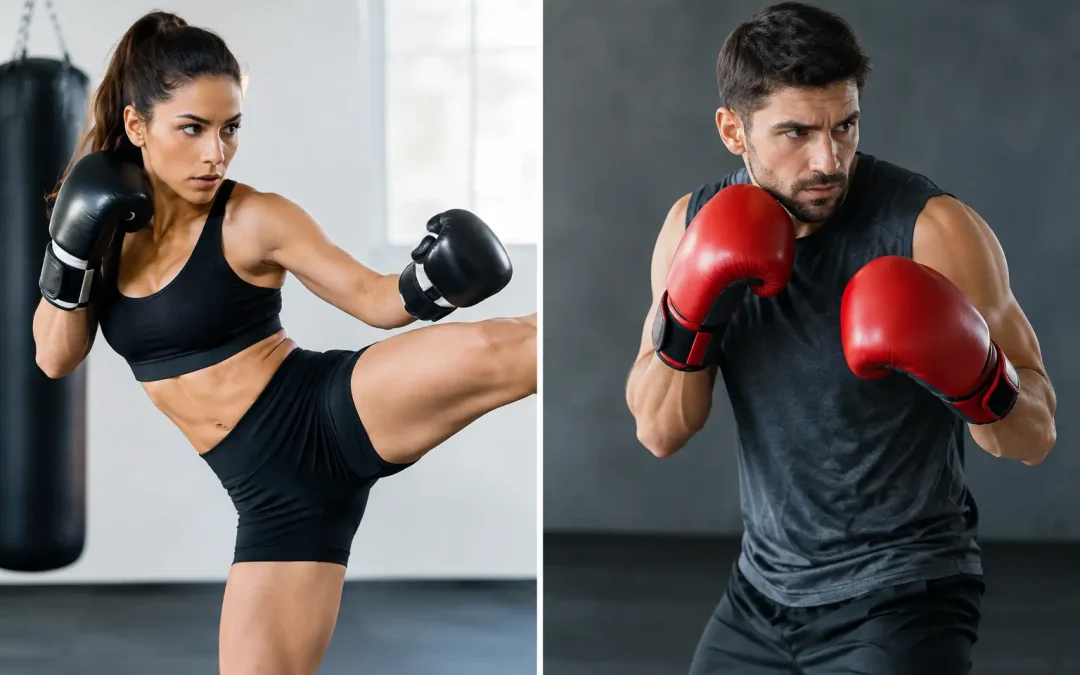
The best workout is the one you can look forward to returning to. If you are choosing kickboxing or boxing for fitness, both can help you get stronger, improve your stamina, and build confidence. The right choice depends less on which style burns more calories and more on what keeps you motivated, comfortable, and consistent.
For many beginners, the question is not about becoming a fighter. It is about finding a positive routine that challenges the body, clears the mind, and feels more rewarding than another hour on a treadmill. Boxing and kickboxing can both do that, but they create a different training experience.
What Boxing Gives You
Boxing focuses on punches, footwork, head movement, balance, and defensive awareness. A good boxing fitness class can be fast-paced without being complicated. You will work on combinations with your hands, move around the floor, use pads or bags, and develop coordination through repeated practice.
Because boxing has a narrower range of techniques, some people find it easier to pick up at first. You can spend more time sharpening a jab, cross, hook, and uppercut while learning how to stand well and move with purpose. That repetition builds fitness quickly. Your shoulders, arms, core, legs, and cardiovascular system all have to work together.
Boxing may suit you if you enjoy quick hand combinations and want a focused, straightforward way to train. It can also be a good choice for someone who wants a high-energy workout but prefers not to kick or is managing limited mobility in their hips, knees, or ankles. A qualified instructor can still adapt drills around individual needs.
The trade-off is that boxing does not offer the same full range of lower-body striking as kickboxing. Your legs will work hard through footwork, squats, and conditioning, but you will not be learning kicks as part of the core skill set.
Why Kickboxing Feels Like a Full-Body Workout
Kickboxing combines boxing-style punches with kicks, knee strikes, movement, and practical defensive skills. That wider range makes each class feel varied. One round might focus on punch combinations, while the next introduces front kicks, round kicks, knees, pad work, or fitness drills.
Your lower body becomes an active part of every session. Kicking requires balance, flexibility, core control, and good posture. It also asks you to coordinate your whole body, rather than relying only on your arms. For adults who spend much of the day sitting, this can be a welcome way to move more fully and improve body awareness.
Freestyle kickboxing is especially appealing for people who want fitness with practical martial arts skills. You are not simply copying exercises. You are learning how to generate power safely, control distance, protect yourself, and stay composed when a drill becomes challenging.
That does not mean you need to arrive fit, flexible, or experienced. Beginner-friendly kickboxing classes break techniques down step by step. The goal is to build good habits over time, not to force high kicks on day one. With regular training, most people notice that movements which once felt awkward become more natural.
Kickboxing or Boxing for Fitness: The Main Differences
Both styles can raise your heart rate, support weight-management goals, improve coordination, and offer a healthy outlet for stress. The biggest difference is the type of movement and variety you want from class.
Boxing is more concentrated. It develops sharp hand skills, movement, rhythm, and upper-body endurance, with plenty of leg work from footwork and conditioning. Kickboxing is broader. It adds lower-body strikes, greater range of motion, and more ways to put combinations together.
Neither is automatically harder. A demanding boxing session can leave you just as tired as a kickboxing class. Equally, a well-taught beginner kickboxing session can be scaled so that a new student feels challenged without feeling overwhelmed. Intensity depends on the class structure, your effort, and your current fitness level.
For people who get bored doing the same gym routine, kickboxing often has the edge because the sessions offer more variety. For people who like refining a smaller set of skills and enjoy fast, punch-led combinations, boxing may feel more satisfying. Try not to choose based only on calorie estimates. Those numbers vary widely from person to person, and they do not tell you whether you will enjoy training next week.
Fitness Is Only Part of the Benefit
A martial arts class gives you more than a hard workout. It gives your training a purpose. Instead of counting reps with no real connection to them, you are learning a skill, responding to coaching, and seeing progress in your technique.
That purpose can make consistency easier. You may first notice that you can finish a round without stopping. Later, you may find your balance is better, your punches are cleaner, or you feel calmer under pressure. Those wins build confidence because they come from effort and discipline, not from comparing yourself with someone else.
There is also a mental reset that many adults value. Training asks you to focus on the next movement, the next combination, and the instructor’s guidance. For an hour, work pressures and daily responsibilities can take a back seat. You leave having moved your body, worked hard, and done something for yourself.
For teenagers and children, the benefits go beyond exercise too. Age-appropriate martial arts training can reinforce focus, respect, listening skills, resilience, and positive routines. The best classes keep the learning structured and enjoyable, with clear boundaries and encouragement for every student.
Choose the Class Environment, Not Just the Style
The quality of the class matters as much as whether it is boxing or kickboxing. A supportive instructor can help a complete beginner feel welcome, explain techniques clearly, and provide options when an exercise needs adjusting. A good club should challenge you while making safety, respect, and control non-negotiable.
Look for a class where beginners are not expected to prove themselves. You should be able to ask questions, work at an appropriate pace, and train alongside people who encourage one another. Pad work and partner drills should be controlled and supervised, while any contact should always follow the club’s rules and your level of experience.
This is particularly important for families. Children need coaching that fits their age, attention span, and stage of development. Adults need an environment where they can learn without feeling intimidated. At Taylor Martial Arts, the focus is on structured training that supports fitness, practical self-defense, confidence, discipline, and a strong local community.
How to Make Your First Classes Count
Wear comfortable workout clothes, bring water, and arrive ready to learn rather than ready to be perfect. You do not need expensive equipment before your first session. Most clubs can tell you what is needed and when it makes sense to buy your own gloves or protective gear.
Start at your own level. It is tempting to throw every punch and kick at full power, especially when the class energy is high. Technique comes first. Learning to turn your hips correctly, keep your hands up, breathe steadily, and stay balanced will make your training safer and more effective as your fitness improves.
Give yourself several classes before making a judgment. The first session may feel unfamiliar because you are learning new movements and names for techniques. By the third or fourth class, you will usually have a clearer sense of whether you enjoy the pace, coaching, and community.
If you are choosing between the two, try kickboxing if you want a varied, full-body martial arts experience with punches and kicks. Try boxing if you prefer to concentrate on hand techniques, footwork, and fast combinations. Either way, choose a class that helps you show up regularly, work with focus, and leave feeling stronger than when you arrived.
Your first step does not have to be a major decision. Take a trial class, meet the instructors, and notice how you feel when the session ends. The style that helps you build a lasting habit is the one that will do the most for your fitness and confidence.
Recent Comments