
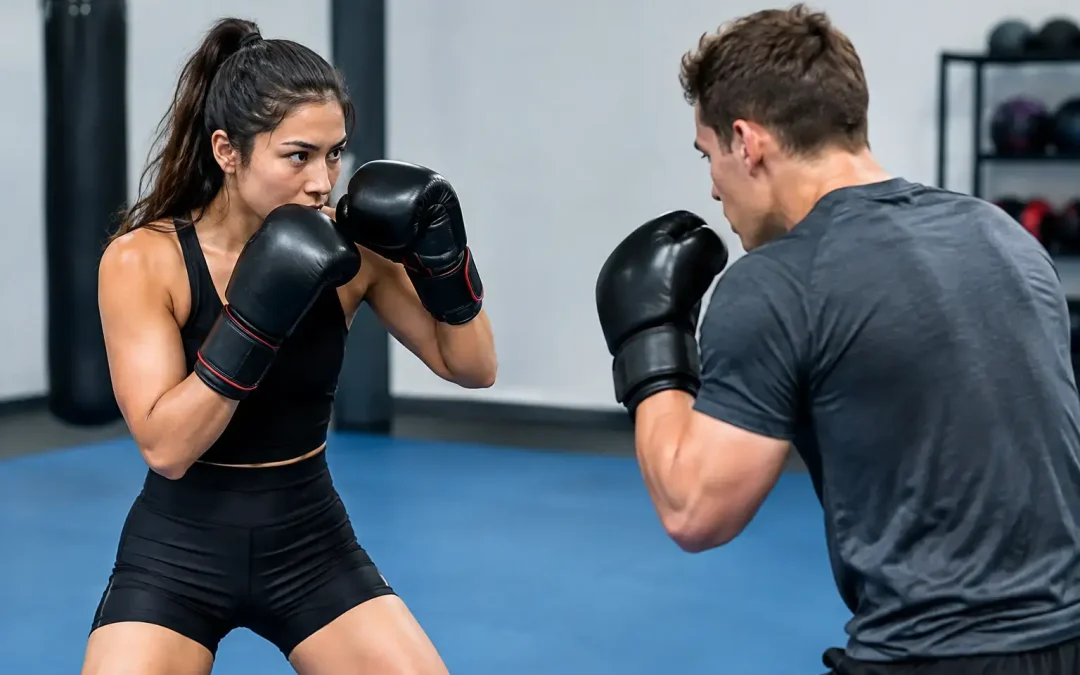
A missed punch rarely starts with slow hands. More often, it starts a few seconds earlier: your guard drops after a combination, your feet stop moving, or your attention follows your own strike instead of your partner’s response. To improve defensive awareness, you need to recognise those small moments before they become openings.
In freestyle kickboxing, good defence is not about standing still and waiting for an attack. It is about staying alert, balanced and ready to make a sensible choice. That might mean stepping back, covering up, moving off line or simply creating space. For children, teenagers and adults alike, this skill builds confidence because it replaces panic with calm, trained reactions.
What defensive awareness really means
Defensive awareness is the ability to read what is happening around you and respond early. In a kickboxing class, that means noticing distance, body position, movement patterns and changes in rhythm. You are not trying to predict every technique perfectly. You are learning to spot the clues that tell you an attack may be coming.
A partner who shifts their weight forwards may be preparing to close distance. A shoulder that turns can signal a punch. A sudden pause after a fast combination may be an invitation for you to rush in without balance. The more regularly you train, the more familiar these signals become.
Awareness also includes understanding your own position. If your hands are low, your chin is raised or your feet are crossed, you are more vulnerable even before your partner moves. A strong defender asks two questions repeatedly: where is my partner, and where am I?
This is why defensive training supports more than self-defence. It develops focus, discipline and self-control. Those are useful habits for a child in school, a teenager handling pressure and an adult managing a busy week.
Improve defensive awareness by protecting your position
The best defensive habits begin with a balanced stance. Keep your feet underneath you rather than too narrow or too wide, with knees soft and weight controlled. Your stance should allow you to move in any direction without having to reset first.
Your guard is equally important. Keep your hands in a position that protects your head while still allowing you to see clearly. Tucking your chin slightly and keeping your eyes on your partner gives you a safer, more composed base. Looking down at the floor, closing your eyes when punches come towards you or turning away are understandable beginner reactions, but they reduce the information you need to respond well.
Do not mistake a tight guard for complete defence. If you stand rooted to the spot with both gloves pressed to your face, you may block a strike but lose your ability to move. Good defence combines protection with posture and mobility. The aim is to stay safe while remaining ready.
Build the habit between combinations
Many students concentrate while they are throwing techniques, then relax for a moment afterwards. That is often the exact moment a partner can counter. Practise returning to guard after every punch, kick and pad sequence, even when no one is attacking back.
At first, this can feel repetitive. It is repetition with a purpose. A reliable return to stance means you do not have to remember your guard only when pressure rises. Your body begins to do the right thing while your mind stays free to read the situation.
Learn to manage distance, not just block attacks
Distance is one of the clearest forms of defence. When you are too close, you have less time to react. When you are too far away, you may overreach and lose balance trying to land a technique. The right distance changes as you and your partner move, so it needs constant attention.
During controlled partner work, notice when you can touch your partner with a straight punch, when a kick reaches safely, and when you need a step before attacking. This is not about being aggressive. It is about understanding range and respecting it.
A simple exercise is to work with a partner at light contact and move without throwing for short periods. One person advances slowly; the other maintains a comfortable range using small steps, a pivot or a controlled retreat. Swap roles. This teaches your eyes and feet to work together without the pressure of trying to score.
Stepping back is useful, but it should not be your only answer. Repeatedly moving straight backwards can leave you near a wall, out of room or off balance. Practise moving diagonally and turning away from the line of attack where appropriate. Your instructor can show you how to do this safely for your level.
Stay calm enough to see the next action
Defensive awareness disappears when people rush. A fast opponent, a noisy class or the worry of making a mistake can cause students to tense their shoulders, hold their breath and react wildly. The answer is not to avoid challenging training. It is to build confidence gradually in a structured setting.
Breathe steadily, especially after you throw a combination. Exhale with effort, reset your stance and look at your partner’s chest and shoulders rather than staring only at their gloves. This wider focus makes it easier to notice forward movement, kicks and changes in body position.
It also helps to give yourself one clear defensive job for each round. For example, focus on keeping your hands high, recognising the first punch of a combination or moving after you defend. Trying to fix everything at once often creates hesitation. One focused goal gives every round a purpose.
For younger students, instructors may use games, light drills and clear commands to build this attention in an age-appropriate way. The lesson is the same: listen, look, keep control and make safe choices. Enjoyment matters, because children learn best when they feel secure enough to try again after an error.
Use partner drills to improve defensive awareness
Controlled partner practice is where awareness becomes practical. Pads help you develop technique, fitness and accuracy, but a moving partner teaches timing, distance and decision-making. Both have a place in a balanced class.
Start with predictable drills. One partner throws a single agreed technique at a safe pace, while the other practises one suitable defence. Once that feels comfortable, add a second option. Perhaps the attacker can use either a straight punch or a hook, and the defender must recognise which response fits.
Later, work with simple combinations and agreed counters. The pace should remain controlled enough for both people to learn. Going too hard too soon can make students flinch, forget technique and stop seeing clearly. A good drill is challenging, but it should not turn into a test of who can hit hardest.
Communication matters here. Work with partners who respect the agreed level of contact, and speak up if the pace is unsuitable. Respect is not separate from martial arts training. It is what allows everyone in the class to improve safely, from complete beginners to more experienced students.
Avoid common defensive mistakes
The most common mistake is reacting to every movement as though it is an attack. Feints are part of kickboxing, but constant overreaction leaves you open and tired. Stay composed, keep your shape and wait for a genuine cue before committing to a large movement.
Another mistake is watching only the hands. Punches matter, but a kick often begins with a shift in the hips or a change in stance. Watching the whole body gives you more useful information than chasing individual gloves with your eyes.
Finally, avoid treating defence as a pause before your next attack. Good defence creates opportunities, but its first job is to keep you safe and balanced. Sometimes the correct response is a counter. Sometimes it is simply moving away and resetting. Knowing the difference shows maturity, not hesitation.
Bring awareness into everyday self-defence
Kickboxing awareness has value beyond the training floor, although class techniques should never be treated as a reason to seek confrontation. In everyday life, practical awareness means noticing your surroundings, keeping space where possible, trusting an uneasy feeling and choosing to leave early rather than proving a point.
For families, this can be a useful conversation. Children do not need to be frightened of the world, but they can learn simple habits: stay with trusted adults, pay attention in unfamiliar places, avoid distractions near roads and know who to ask for help. Teenagers and adults can benefit from the same calm, sensible mindset.
The aim of self-defence is safety. Avoidance, clear boundaries and getting help are often better choices than physical action. Martial arts training gives students greater confidence, but confidence should be paired with responsibility.
At Taylor Martial Arts, students are encouraged to build these habits one class at a time: show up, listen carefully, support training partners and keep improving. Whether you are helping a child grow in confidence or returning to exercise as an adult, defensive awareness is not a talent reserved for experienced fighters. It is a skill built through patient practice, respectful coaching and the decision to stay focused when it matters.
Recent Comments