
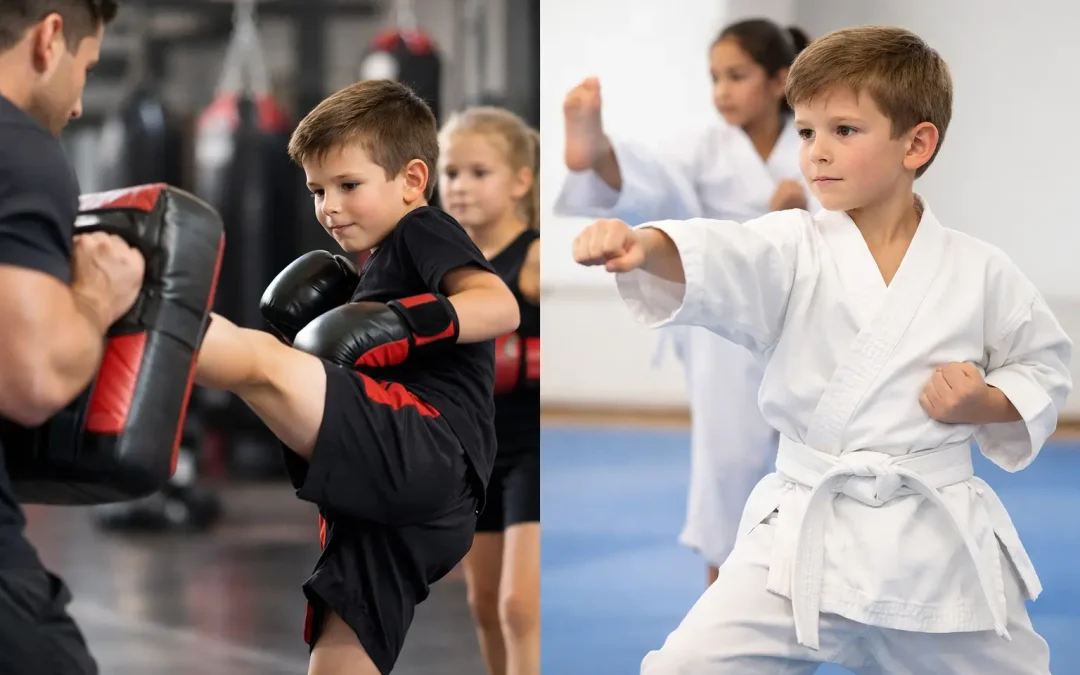
A child who struggles to speak up, burns off energy after school, or needs a routine they can feel proud of may benefit from martial arts. When parents compare kickboxing vs karate for kids, the best choice is rarely about picking the “tougher” style. It is about finding a class where your child feels safe, supported, challenged, and excited to return.
Both kickboxing and karate can help children build fitness, confidence, focus, and respect. The differences are in how they train, what they emphasize, and how naturally they suit your child’s personality and goals.
Kickboxing vs Karate for Kids: The Main Difference
Karate is a traditional martial art with roots in Japanese training systems. Classes often include set patterns, known as kata, formal stances, techniques, belt progress, and clear traditions around etiquette. Many children enjoy the structure and sense of achievement that comes from learning a sequence precisely and moving through grades.
Kickboxing is generally more movement-based and practical in its approach. Children learn punches, kicks, footwork, guarding, balance, and controlled partner drills. A well-run kids kickboxing class is not about encouraging children to fight. It is about teaching them how to move with confidence, make sensible choices, stay calm under pressure, and use their bodies with control.
The right program in either style should be age-appropriate. Young children need simple instructions, encouragement, and activities that develop coordination. Older children and teens can take on greater technical detail, fitness challenges, self-defense awareness, and personal responsibility.
What Karate Can Offer Your Child
Karate can be an excellent fit for children who respond well to routine, detail, and tradition. They may enjoy practicing a pattern until it feels smooth, working toward the next belt, and learning the meaning behind their training rules.
The formal structure can help children understand respect in a practical way. They learn to listen when an instructor is speaking, take turns, train with care, and recognize that progress comes from consistent effort. For a child who benefits from clear expectations, this can be very positive.
Karate also builds coordination, posture, balance, and body awareness. Repeating techniques helps children understand how to place their feet, use their hands, and move with purpose. The pace can vary between schools, though. Some karate programs spend more time on forms and technical precision than on fitness-based drills or practical partner work.
That is not a weakness. It simply means parents should ask what a typical class looks like. If your child loves learning sequences and enjoys a more formal setting, karate may be a strong match.
Why Many Kids Enjoy Kickboxing
Kickboxing often feels active from the first lesson. Children can expect to practice combinations, pads, movement games, kicking drills, and fitness exercises designed for their age group. For children who find it hard to sit still after a long school day, that energy and variety can be a real advantage.
A good kickboxing program teaches children to keep their hands up, stay balanced, use controlled power, and focus on the task in front of them. These are physical skills, but they also support life skills. A child who learns to reset after making a mistake during a drill is practicing resilience. A child who works carefully with a partner is practicing respect and self-control.
Freestyle kickboxing can also feel more immediately relevant to children and teens because it uses natural movement, punching, kicking, and defensive awareness. Training should always be controlled and supervised, especially for beginners. Contact is not the goal. Building confidence, fitness, and good habits is.
For many families, kickboxing is especially appealing because children can see progress quickly. They may notice stronger balance, better coordination, more energy, and greater confidence within their first few weeks of regular classes.
Confidence Is Not About Fighting
Parents sometimes worry that martial arts may make their child aggressive. In a positive club, the opposite should be true. Children learn that strength comes with responsibility, and that self-control matters more than showing off.
Both karate and kickboxing can help a quiet child find their voice. They may learn to stand taller, make eye contact, answer clearly, and trust that they can try something unfamiliar. For an energetic child, martial arts can provide a healthy outlet while reinforcing boundaries and listening skills.
The instructor and class culture matter more than the name of the style. Look for a program where children are corrected calmly, praised for effort, and encouraged to support one another. The best classes do not only celebrate the fastest or strongest child. They recognize focus, kindness, perseverance, and improvement.
Fitness, Focus, and Healthy Routine
Children do not need to think of martial arts as exercise for it to improve their fitness. Regular training develops stamina, flexibility, mobility, core strength, coordination, and cardiovascular health through purposeful activity.
Kickboxing classes may offer more continuous movement, which can be useful for children who enjoy fast-paced training. Karate can build focus and control through repetition, stance work, and structured practice. Both can reduce screen time and give children a positive weekly routine outside school.
Consistency is where the bigger benefits appear. Attending class once is fun. Attending regularly teaches a child that progress is earned over time. They discover that a difficult kick can improve, a new combination can become familiar, and a challenging class can be completed with effort.
Those lessons carry into homework, sports, friendships, and everyday responsibilities.
How to Choose Between Kickboxing and Karate
Start with your child, not the label on the door. A child who loves action, pad work, and fast-moving drills may be drawn to kickboxing. A child who enjoys rituals, careful technique, and learning a set sequence may prefer karate.
Age matters, too. Younger children often need a class built around movement, listening games, basic coordination, and simple rules. Teens may want training that feels physically challenging and gives them practical confidence. In either case, avoid choosing a class solely because a friend attends or because it seems more impressive.
It also helps to consider what you want your child to gain. If your priority is a highly traditional martial arts experience, karate may be the natural choice. If you want practical movement, fitness, controlled self-defense skills, and an energetic class environment, freestyle kickboxing could be a better fit.
There is no need to make the decision from a website or a description alone. A trial class lets your child experience the atmosphere, meet the instructor, and see whether they feel comfortable participating. Watch how the class is organized. Are children welcomed by name? Are instructions clear? Is discipline firm but encouraging? Do students leave looking proud of themselves?
Questions Worth Asking Before You Enroll
Ask whether classes are separated by age and experience, how instructors introduce partner drills, and how progress is recognized. Find out whether the club emphasizes respect, safe technique, and personal development alongside physical training.
You can also ask what happens when a child is nervous, distracted, or new to exercise. The answer will tell you a great deal about the teaching approach. Every child has an uncertain first lesson. The right instructor knows how to give them a manageable first step rather than expecting instant confidence.
At Taylor Martial Arts, children are encouraged to train at their own starting point while developing the discipline, focus, fitness, and self-belief that grow through regular practice. A free trial can give your family a clear sense of whether kickboxing feels like the right next step.
The best martial art for your child is the one that helps them walk into class with curiosity and leave feeling stronger than when they arrived. Give them a supportive place to practice, a coach who expects their best, and enough time to discover what they can do.
Recent Comments