
Is your child’s endless energy a sign of athletic talent or a signal that they need more structure? Many parents wait for a specific birthday to start, but chronological age is often the least important factor. You are likely looking for the specific signs child ready for martial arts because you want to ensure they are set up for success from day one.
It’s normal to feel anxious about whether your child can focus at school or if they will struggle with social integration. You might even worry that combat sports could encourage aggressive behaviour. We understand these concerns and want to help you find a welcoming community where your child feels safe to grow. This article reveals the developmental milestones and behavioural cues that signal your child is ready to thrive in a structured martial arts environment. We will walk through seven clear indicators to help you decide if 2026 is the year your child starts their journey toward better discipline and confidence.
Key Takeaways
- Focus on developmental milestones rather than just birth years to ensure your child is ready for the mental and physical challenge.
- Learn how to spot social curiosity and peer interaction cues that indicate a readiness for structured group environments.
- Identify the specific signs child ready for martial arts, such as directionless energy that needs a positive and disciplined outlet.
- Use our simple five-minute home assessment to gauge your child’s interest and coordination before starting.
- Discover how structured martial art lesson programmes provide the mentorship and community your child needs to build lifelong confidence.
Beyond the Birthday: Why Development Trumps Age in Martial Arts
Stop checking the calendar. A child’s age is just a number. It doesn’t tell the whole story of their maturity or coordination. Readiness is a spectrum of physical, cognitive, and social milestones. At Taylor Martial Arts, we focus on developmental stages rather than just birth years. Some children are ready to jump in at four; others might benefit from waiting until six. We look for the individual, not the birth certificate. This approach ensures every student feels capable and motivated from their very first session.
It’s helpful to define what we mean by “Structured Martial Arts Training.” This isn’t a random play session or an unsupervised gym. It is a curriculum-based group learning experience. Your child will move from simple play-based activity to goal-oriented learning. They start to understand that consistent effort leads to tangible progress. This transition is vital for building resilience. They aren’t just burning off steam; they are following a path toward specific skills and achievements.
This structured approach offers more than just physical fitness. Research into martial arts therapy shows it can significantly improve self-esteem and reduce stress in children. By moving away from “just for fun” and toward a clear programme, children learn to manage their emotions and focus their minds. These are the real signs child ready for martial arts. When they can commit to a task, they are ready for the mat.
The ‘Reception Year’ Benchmark in the UK
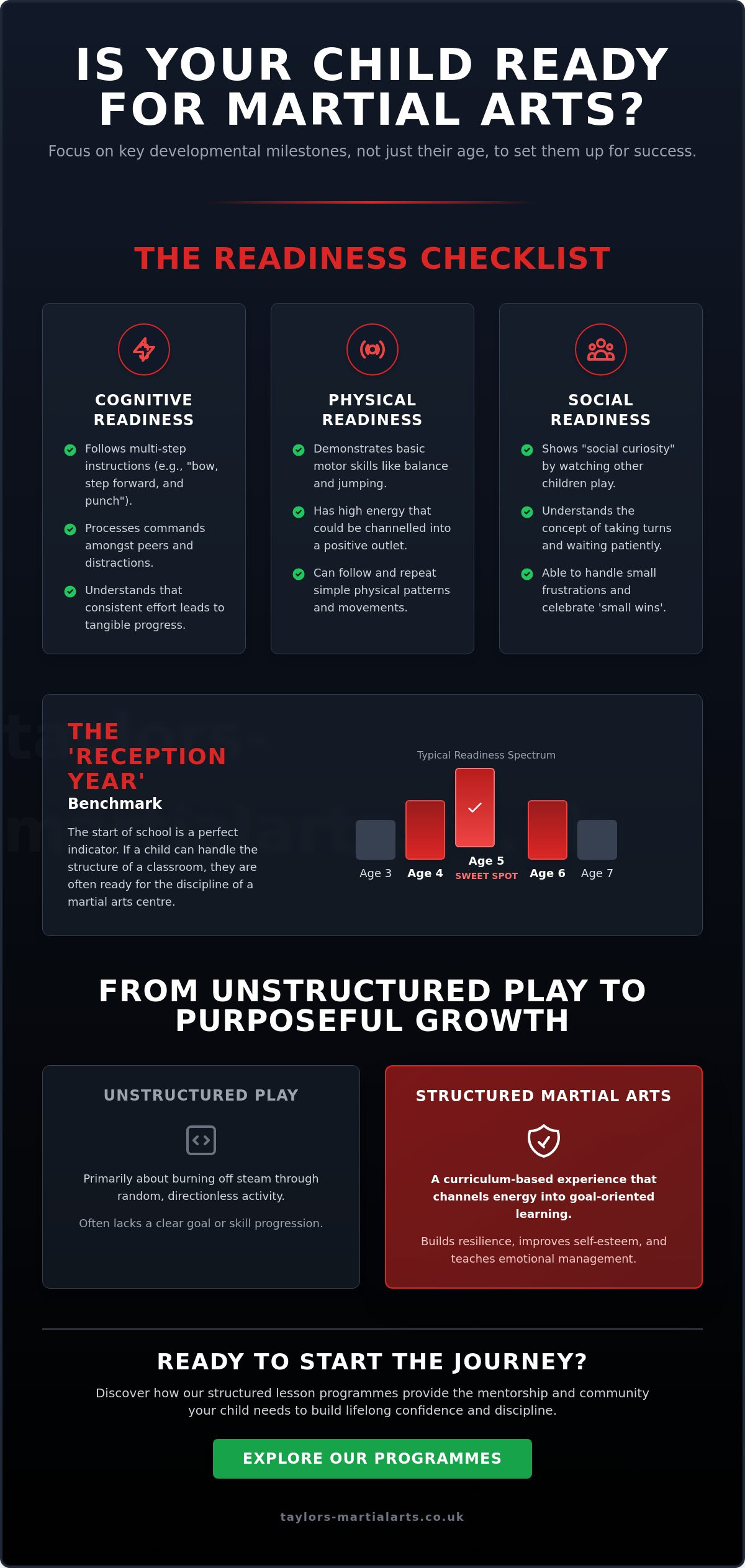
The start of school is a perfect indicator of readiness. In the UK, the Reception year introduces children to structured environments outside the home. They learn to listen to a teacher amongst their peers. They begin to follow complex instructions and wait their turn. This makes the ages of 4 to 6 the “sweet spot” for starting a martial arts programme. If they can handle the expectations of a classroom, they can usually handle the discipline of a martial arts centre.
Physical vs. Cognitive Readiness
Don’t confuse physical energy with readiness. A child might be able to kick high but struggle to stay in line or wait for a command. You need to look for basic motor skills like balance, jumping, and the ability to follow simple patterns. Physical skill is only half the battle. Cognitive readiness is the ability to process multi-step tasks. If your child can follow a sequence like “bow, step forward, and punch,” they have the mental focus required to thrive. Identifying these signs child ready for martial arts ensures they enjoy their first lesson rather than feeling overwhelmed by the process.
The Social Checklist: Readiness for Group Martial Arts Programmes
Observe your child at the local park or a busy play centre. Do they watch other children with a mix of wonder and hesitation? This “Social Curiosity” is a major indicator that they are prepared for a group environment. They don’t need to be the most outgoing child in the room. In fact, many of our most successful students started as quiet observers. The desire to join in, even if they haven’t quite found the courage yet, is one of the vital signs child ready for martial arts.
Group dynamics are different from one-on-one play. Your child needs to understand the concept of “Turn Taking.” In a martial arts hall, students often wait for their turn to strike a pad or perform a movement. This requires patience and a basic respect for their peers. For children who struggle with social boundaries, a structured programme provides a clear set of rules. It removes the guesswork from social interaction. Every student knows where to stand and when to move. For parents of neurodivergent children, these structured environments offer specific benefits for kids who learn differently, helping them navigate social hurdles through clear, repetitive routines.
Following Instructions in a Peer Group
Can your child follow a two-step instruction whilst amongst other children? It is easy to listen to a parent at home with no distractions. It is much harder to listen to a Lead Instructor when ten other children are jumping around. We look for children who can process simple commands like “find your space and stand still.” Listening to an instructor introduces a new type of authority. This helps build character and resilience. If you see these social cues developing, it might be time to explore our programme martial art lessons to see how your child fits into a supportive group setting.
Handling Frustration and ‘The Small Wins’
Martial arts is about trial and error. Your child will make mistakes. They will miss a kick or forget a step in a pattern. Resilience is the ability to try again without a meltdown. We use the belt system to provide a framework for emotional regulation. It teaches children that progress takes time. They learn to celebrate “small wins” whilst working toward a long-term goal. If your child can accept a gentle, constructive correction from an adult, they are ready for the mat. This maturity allows them to transform frustration into focus, which is a key skill for life beyond the training hall.
Harnessing Energy: Behavioural Signs Your Child Needs Structure
Many parents worry that martial arts will encourage aggression. This is a common misconception. In reality, it does the opposite. We don’t teach children how to fight; we teach them how to control their bodies and minds. If your child is constantly wrestling on the sofa or fidgeting during dinner, they aren’t being “wild.” They have directionless energy. This is one of the clearest signs child ready for martial arts. They are searching for a way to use their physical power, and a weekly programme provides that much-needed constructive outlet.
High-spirited children often face a “Focus Gap.” These are bright, capable kids who simply struggle to channel their attention toward one task. They might excel at home but feel restless in quiet environments. Martial arts bridges this gap by making focus a physical activity. Instead of being told to “sit still,” they are told to “stand in this specific stance.” It turns the act of paying attention into a challenge they want to win. This mental engagement is vital. It stops the mind from wandering and grounds the child in the present moment.
From ‘Rough-Housing’ to Disciplined Movement
Children who love physical play usually thrive in a controlled environment. The Dojo or training centre acts as a safe space with clear boundaries. We establish exactly when it is appropriate to be physical and when it is time to be still. By learning the “Why” behind every movement, children stop “rough-housing” and start practising. They learn that their strength has a purpose. This transition from chaotic play to disciplined movement builds a deep sense of self-respect. It teaches them that being “strong” also means being “self-controlled.”
Improving Focus and School Behaviour
Standard school PE is great, but some children seek more of a challenge. If your child seems bored with basic games, they might need the structured progression of a martial arts course. The discipline practised on the mat carries directly over into the classroom. Teachers often notice an improvement in how these students sit and listen. They learn that focus is a skill that can be improved, just like a kick or a punch. When a child begins to apply these lessons at school, you know you’ve found the right signs child ready for martial arts. It builds a foundation of respect for authority and peers that lasts a lifetime.
The ‘Ready or Not’ Home Assessment for Parents
You have observed the social cues and the high energy levels. Now it is time to move from observation to action. You don’t need a black belt to figure out if your child is prepared for the mat. A simple five-minute assessment at home can reveal the most important signs child ready for martial arts. This isn’t about physical talent; it is about the mental and emotional willingness to engage with a new challenge.
The Two-Step Instruction Test
Try this simple drill today. Give your child two unrelated tasks to complete in order. For example, ask them to “put your favourite toy in the box and then bring your trainers to the front door.” A child who can follow a two-part instruction at home is likely ready for the basic drills of a martial arts programme. Watch how they react if they get it wrong. If you offer a gentle correction, do they listen and try again, or do they become frustrated? Martial arts involves constant feedback. If they can handle a small “tweak” to their movement without a meltdown, they have the emotional maturity required for a group class.
Gauging Interest and Curiosity
Ask your child what they think about martial arts, but don’t coach their answer. Listen to what excites them. Are they drawn to the uniform or the “cool moves” they’ve seen on TV? Both are valid starting points. However, a child’s personal “Yes” is vital for long-term success. If they are curious about how to move their body or how to earn a belt, they are already mentally invested. This internal motivation is far more powerful than a parent’s desire for them to be more disciplined. Look for that spark of curiosity; it is one of the most reliable signs child ready for martial arts.
The ultimate diagnostic tool is always the trial lesson. No home test can perfectly replicate the atmosphere of a training centre. A trial allows your child to feel the floor, meet the instructor, and see the other students in action. It is also a test for you. Consider your own “Parental Readiness.” A successful journey requires a commitment to a weekly schedule. You are the one who will provide the transport and the encouragement on the days they feel tired. If you are ready to support their progress, then the final piece of the puzzle is in place. Register for a free trial to see if our programme is the right fit for your family’s routine and your child’s development.
Starting the Journey with Taylor Martial Arts in Carshalton
Once you have identified the signs child ready for martial arts, the next step is finding the right environment. Our Carshalton centre is designed specifically for local families who value professional, mentor-led guidance. We don’t offer random drop-in sessions. Instead, we provide comprehensive programmes martial art lessons that guarantee a steady path of progression for every student. This structured approach ensures your child builds a solid foundation of discipline from their very first day on the mat.
We invite you to visit our training hall and observe a session in action. Seeing the group dynamic first-hand helps you understand how we manage energy and focus. Our centre is a safe, professional space where local children learn to respect themselves and others. It’s the perfect place to turn that directionless energy we discussed earlier into a source of pride and achievement. We are more than just a gym; we are a community-minded partner in your child’s development.
Our Structured Curriculum for Kids
We organise our lessons to balance high-energy fun with serious skill-building. Whether your child is in our “Kidzone” for ages 6 to 9 or our older “Kids” group, they will follow a clear path. This curriculum helps them set goals and celebrate their progress. Being part of the Carshalton community allows them to make new friends whilst developing resilience amongst their peers. Our instructors act as supportive mentors who are deeply invested in your child’s personal transformation. They provide the encouragement needed to turn those initial signs child ready for martial arts into lifelong habits of success.
Book a Trial at Our Carshalton Centre
Enrolling in your first martial arts course is a straightforward process. We recommend starting with a free trial class to ensure the environment is a good fit for your family. Your child doesn’t need a uniform to begin. Just bring them in comfortable clothes and an open mind. We handle everything else. You’ll see how our freestyle kickboxing approach builds confidence and fitness in a way that standard school activities often can’t match.
Discover our kids’ martial arts programmes in Carshalton today and take the first step toward a more disciplined, confident future for your child.
Empower Your Child’s Growth in 2026
Deciding to start a new activity is a big step for any family. You now have a clear framework to identify the signs child ready for martial arts, from observing social curiosity to testing focus with simple home drills. Remember that readiness isn’t about hitting a specific age. It’s about finding the right moment when your child’s physical energy and mental maturity align. Our structured curriculum-based programmes are designed to meet them exactly where they are. We provide a high-energy, inclusive environment for all abilities at our professional Carshalton-based training facility.
Take the next step and see the transformation for yourself. Our instructors are ready to act as mentors, guiding your child through every milestone. Book a trial lesson for your child at our Carshalton centre today. It’s time to turn that restless energy into lasting confidence and discipline. We look forward to welcoming you to our local community and starting this journey together.
Frequently Asked Questions
What is the best age for a child to start martial arts in the UK?
Most children are developmentally ready to start between the ages of 4 and 6. This period aligns with the UK Reception year, where children begin to follow structured instructions in a group setting. Whilst some children show readiness earlier, this age range is often the sweet spot for balancing physical coordination with the mental focus required for a programme.
My child is very shy; will they be overwhelmed in a group martial arts programme?
No, our inclusive environment is specifically designed to support children of all personality types. Many of our most confident students started as quiet observers who were hesitant to join in. Our instructors act as supportive mentors, helping shy children build their confidence at a pace that feels safe and encouraging for them.
Does martial arts encourage children to be more aggressive or violent?
Martial arts actually reduces aggression by teaching self-control, respect, and discipline. We establish very clear boundaries regarding where and when physical skills should be used. By providing a constructive outlet for energy, we teach children that true strength comes from being able to manage their impulses and stay calm under pressure.
What should my child wear to their first martial arts lesson in Carshalton?
Your child should wear comfortable, loose-fitting sports clothing like a T-shirt and tracksuit bottoms or leggings. They do not need a traditional uniform for their first few sessions. We want them to focus on the movement and the fun of the class. Just ensure they have a bottle of water and are ready to move.
How long does it take for a child to see the benefits of martial arts training?
You may notice small improvements in focus and energy levels after just a few sessions. More significant changes, such as improved physical coordination and emotional resilience, typically develop over several months of consistent attendance. Every child’s journey is unique, but the positive impact on their self-esteem is often visible quite early on.
Can martial arts help with my child’s behaviour and focus at school?
Yes, the discipline learned on the mat translates directly to the classroom. Many parents find that the ability to follow multi-step instructions and stay focused on a task is one of the key signs child ready for martial arts. Teachers often report an improvement in how these students listen and interact with their peers after they start training.
Is martial arts safer than other team sports like football or rugby?
Martial arts training in a professional centre is very safe and often has lower injury rates than high-impact sports like rugby. Our sessions are highly controlled and led by qualified instructors who prioritise proper technique and safety. We use protective mats and follow strict guidelines to ensure every child can learn in a secure environment.
Do I need to buy any equipment before my child starts their first course?
You don’t need to buy any specialised equipment before your child starts their first session. We provide all the necessary training gear at our Carshalton centre for newcomers. Once you decide to commit to a full programme, we will guide you through the process of getting a uniform and any personal protective gear they might need.
Recent Comments