
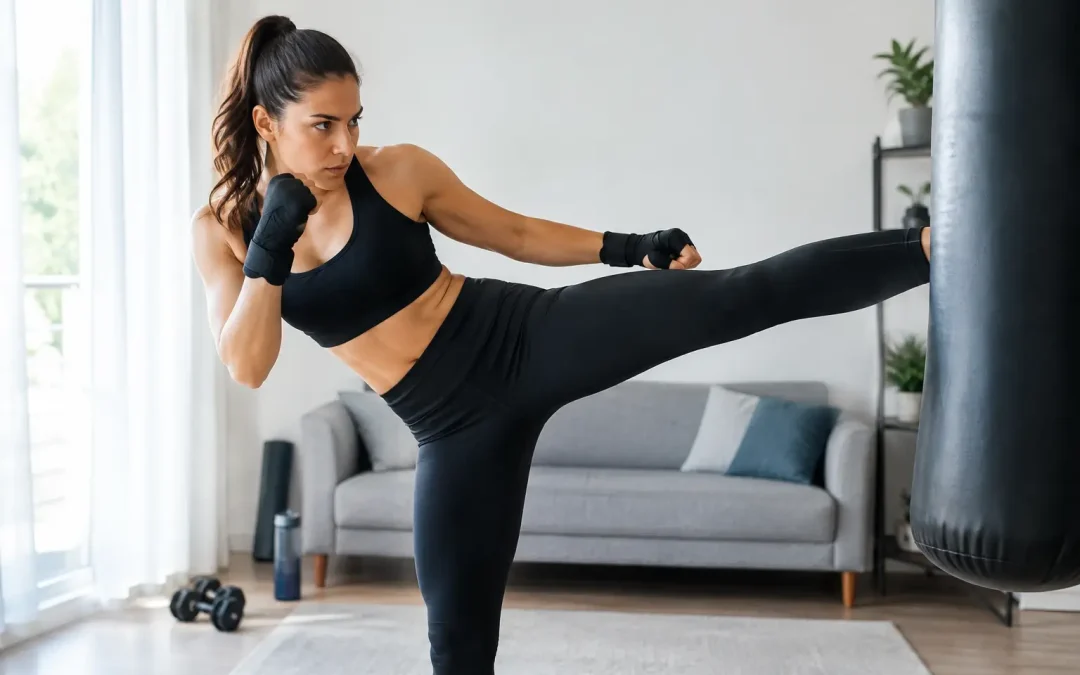
A few focused minutes at home can make a real difference to how you feel in your next class. The best top kickboxing home exercises do not require a heavy bag, a large gym, or advanced experience. They build the foundations that matter most: balance, coordination, fitness, control, and confidence.
For families, home practice should feel positive rather than pressured. Children benefit from short, structured movement sessions that develop focus and listening skills. Adults can use the same principles to improve fitness, relieve stress, and reinforce practical kickboxing technique. The goal is not to train at full intensity every day. It is to create a healthy routine that supports progress.
Start With Space, Safety, and Good Form
Before throwing a punch or kick, make the area safe. Clear away furniture, toys, loose rugs, and anything that could be knocked over. You need enough room to extend your arms and move one or two steps in each direction without contact.
Wear comfortable clothing and supportive footwear if the floor is hard or slippery. If you are practicing barefoot, make sure the surface is clean and secure. Children should practice with a parent nearby, especially when working on kicks, jumping movements, or faster combinations.
Keep every movement controlled. Power comes later. A clean technique practiced slowly is far more valuable than an uncontrolled kick thrown at speed. Good posture, hands in guard, and awareness of balance are habits worth building from the first session.
Top Kickboxing Home Exercises for Beginners
A simple home session can last 15 to 25 minutes. Start with a warm-up, choose a few skill exercises, then finish with a calm stretch. Beginners should aim for consistency two or three times a week rather than trying to do too much at once.
Fighting Stance and Guard Practice
Your stance is the platform for every punch, kick, block, and movement. Stand with one foot slightly in front of the other, knees soft, weight balanced, and hands held high near the face. Keep your chin tucked and your eyes forward.
Practice stepping forward, backward, and sideways without crossing your feet. Move lightly, then return to a stable stance each time. This may look simple, but it teaches body control and helps prevent the common beginner habit of standing too square or losing balance after a technique.
For younger students, turn it into a listening exercise. Call out “forward,” “back,” “left,” “right,” and “freeze.” They will be developing coordination, focus, and self-control at the same time.
Shadowboxing for Technique and Fitness
Shadowboxing means practicing movements in the air without hitting a partner or equipment. It is one of the most useful exercises for home because it develops technique, rhythm, and cardiovascular fitness while keeping the focus on control.
Begin with single punches. Practice a jab from the front hand, bringing it straight out and returning it quickly to guard. Then add a rear straight punch, turning the hip and shoulder slightly while keeping the other hand up. Do not lock out the elbow or throw punches wildly.
Once the punches feel comfortable, work on simple combinations such as jab-cross, jab-cross-jab, or jab-cross followed by a step back. Practice for 30 seconds, rest for 30 seconds, and repeat three to five times. Adults can increase the pace gradually. Children will often benefit more from shorter rounds with clear goals, such as keeping their hands up for the full round.
Controlled Front Kicks
Front kicks are excellent for developing balance, core strength, and lower-body control. Begin in your stance, raise the knee first, extend the foot gently forward, bring the knee back in, and return to your stance. Think of it as four separate stages: lift, extend, retract, and reset.
Avoid kicking as high as possible. A lower kick with correct balance is safer and more useful than a high kick that causes the body to lean backward or the hands to drop. Hold a chair or wall lightly for support if balance is still developing, but do not rely on it forever.
Try five controlled kicks on each side, rest, then repeat for two or three rounds. For a family challenge, count how many kicks each person can perform with steady posture and no wobbling. Quality wins over speed.
Squats and Lunges for Stronger Legs
Kickboxing asks a lot from the legs. Strong legs help you stay balanced, move quickly, and generate power without losing control. Bodyweight squats and reverse lunges are simple ways to build that strength at home.
For a squat, stand with feet about shoulder-width apart, sit the hips back as if lowering into a chair, and keep the chest lifted. Only go as low as feels comfortable while keeping the knees in line with the toes. For reverse lunges, step one foot back, lower with control, then push through the front foot to return to standing.
Start with eight to 12 squats and six reverse lunges on each side. If this feels too challenging, reduce the range of movement. If it feels easy, slow down the lowering phase instead of rushing through more repetitions.
Plank Holds for Core Control
A strong core supports every technique. It helps you turn through punches, stay stable when kicking, and maintain posture when you are tired. Planks are a straightforward way to train it.
Place your forearms on the floor with elbows under the shoulders, extend your legs behind you, and form a straight line from shoulders to heels. Keep the hips level rather than letting them sag or lift too high. Beginners can place their knees on the floor and still receive real benefits.
Hold for 15 to 30 seconds with steady breathing. Two or three good holds are enough. For children, use a short timer and celebrate good form rather than making it a competition to hold the longest.
Footwork Lines and Direction Changes
Quick feet are not about running around the room. They are about moving with purpose while staying ready to defend yourself. Use a line in the floor pattern, a piece of tape, or an imaginary line as a guide.
Step forward and back along the line while staying in stance. Then add side steps. Keep your feet under control, avoid crossing them, and maintain your guard. After a few rounds, add a jab-cross combination at the end of each movement.
This exercise is especially helpful for people who feel comfortable punching in place but lose their shape as soon as they move. It also gives children a structured way to use energy while practicing concentration.
Build a Routine You Can Keep
The most effective home practice is realistic. A 20-minute session completed regularly will do more for confidence and fitness than an ambitious workout that only happens once. Choose a consistent time, such as after school, before dinner, or before an evening shower.
A balanced session might include three minutes of light movement, five minutes of stance and footwork, five minutes of shadowboxing, five minutes of kicks and leg strength, and a short stretch. Adjust the time to suit your age, fitness level, and space.
Avoid practicing hard techniques on walls, doors, furniture, or improvised targets. Kicking and punching solid objects can cause injury, particularly to wrists, ankles, toes, and knees. A home routine is best used for movement quality, fitness, and technique rehearsal. Partner drills and contact training need qualified supervision, clear rules, and appropriate equipment.
Make Practice Part of Family Life
For parents, the greatest benefit may be the example you set. Joining your child for a few minutes of stance practice or a light workout shows that discipline and wellbeing are lifelong skills. Keep the atmosphere encouraging. Correct gently, praise effort, and remind children that improvement happens one repetition at a time.
At Taylor Martial Arts, class training gives students the coaching, structure, and community needed to develop safely. Home exercises are a valuable addition because they help students arrive ready to learn, remember key skills, and take pride in their progress between sessions.
Set a small goal for your next practice: a steadier guard, five better front kicks, or one extra round of controlled shadowboxing. That quiet commitment to showing up is where confidence starts to grow.
Recent Comments